
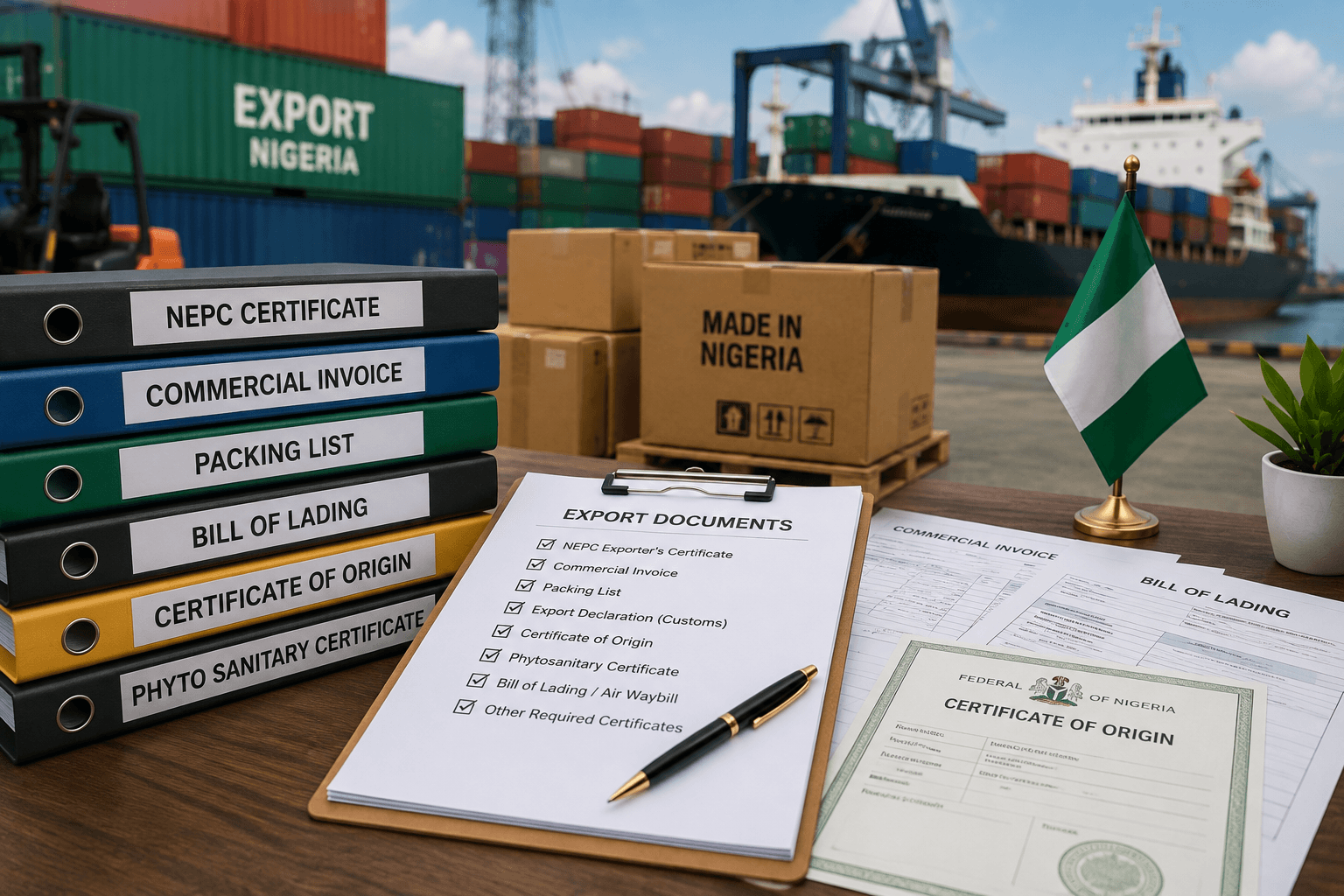
Documents Required for Export in Nigeria
The documents required for export in Nigeria depend on what you are exporting, where it is going, and how the goods will be shipped. Some documents form part of the general export process, while others are required only for specific products, destinations, or transactions.
For Nigerian exporters, this may include exporter registration, commercial documents, customs documentation, product-specific certificates, shipping documents, and, in some cases, a Certificate of Origin or destination-country permits.
This guide explains the main export documents in Nigeria, what each one is used for, and how to determine which documents you need before shipping your goods.
What Documents Do You Need to Export from Nigeria?
There is no single document checklist that applies to every Nigerian export. The export documents you need depend on your product, destination, transport method, and the requirements of the transaction.
Examples
- Exporter documentation
- NEPC Exporter's Certificate
- Commercial documents
- Pro forma invoice, commercial invoice, packing list, export contract
- Customs documentation
- Export declaration and applicable customs documents
- Product-specific documents
- Phytosanitary, NAFDAC, veterinary and other certificates
- Origin documents
- Certificate of Origin
- Shipping documents
- Bill of Lading, Air Waybill and other carrier documents
- Destination documents
- Import permits and destination-country certificates
Some of these documents are commonly used in the export process, while others apply only when required by the product, destination, regulator, buyer, or shipping method. Confirm the requirements that apply to your specific export before preparing your shipment.
1. NEPC Exporter's Certificate
The Nigerian Export Promotion Council (NEPC) is responsible for promoting and developing non-oil exports from Nigeria. Businesses intending to export commercially need to complete NEPC registration and obtain an Exporter's Certificate as part of the export process.
Before registering with NEPC, your business should also have its appropriate Corporate Affairs Commission (CAC) registration and business information in order. The registration process is completed through the NEPC registration portal, where exporters provide the required business information and supporting documents. The exact NEPC registration requirements depend on the type of business and the application process.
It is important to keep your exporter registration details up to date and check NEPC's current requirements before applying. If you are looking for a detailed walkthrough of the process, a separate guide on NEPC registration in Nigeria can cover the application steps, requirements, and registration portal in more detail.
2. Commercial Export Documents
Commercial documents provide the basic details of the transaction and help the exporter, buyer, banks, customs authorities, and logistics providers understand what is being shipped.
- Pro forma invoice: A preliminary invoice that outlines the proposed sale, including the products, quantities, prices, and other agreed terms.
- Commercial invoice: Records the final sale and provides details such as the goods, value, buyer, and seller.
- Packing list: Describes how the goods are packaged, including quantities, package types, weights, and dimensions where relevant.
- Export contract or sales agreement: Records the terms agreed between the exporter and buyer, including the product, price, payment terms, delivery responsibilities, and other conditions.
Not every transaction will use these documents in exactly the same way, but keeping accurate commercial records helps ensure the information remains consistent across the export process.
3. Customs and Export Declaration Documents
Before goods leave Nigeria, exporters must complete the applicable customs and export declaration requirements. These procedures allow the relevant authorities to assess the shipment and ensure it meets the requirements for export.
The documentation involved may include an export declaration, customs-related forms, and supporting documents for the shipment. Exporters may also need to complete the Nigeria Export Proceeds (NXP) Form as part of the export process, depending on the transaction and current requirements.
Because customs procedures and documentation can change, check the current requirements with the Nigeria Customs Service before shipping. Your freight forwarder or customs agent can also help ensure the required declarations and supporting documents are prepared correctly.
4. Product-Specific Certificates and Approvals
Not every exporter needs the same certificates. Additional approvals or certificates may be required depending on the product, regulatory authority, destination country, or buyer's requirements.
For example, exporters may need:
- Phytosanitary certificates for certain plant and agricultural products.
- NAFDAC certificates or approvals for regulated products such as food, drugs, cosmetics, and medical devices.
- Veterinary certificates for certain animal and animal-derived products.
- Certificates of Analysis or quality certificates where required by the product, buyer, regulator, or destination market.
- Other permits or licences for products subject to specific controls.
Before exporting, identify the requirements that apply to your product and confirm which certificates or approvals are needed. This helps you avoid preparing unnecessary documents or discovering additional requirements after an order has already been agreed.
The important point is that these are conditional export documents, not documents every Nigerian exporter needs.
5. Certificate of Origin
A Certificate of Origin identifies the country where goods originate. It may be required by the buyer, destination country, customs authorities, or a specific trade arrangement.
The type of Certificate of Origin required can depend on where you are exporting and whether the shipment is being made under a preferential trade agreement. For example, exporters trading under arrangements such as AfCFTA or ECOWAS trade schemes may need the appropriate certificate to claim preferential treatment where applicable.
Do not assume that every export from Nigeria requires a Certificate of Origin. Confirm whether the destination, buyer, or applicable trade arrangement requires one and which type is appropriate for your shipment.
6. Shipping and Transport Documents
The documents required for transporting your goods will depend on how the shipment is being moved and the carrier handling it.
Common examples include:
- Bill of Lading: Used for goods transported by sea and issued by the carrier as evidence of the shipment and the terms of carriage.
- Air Waybill: Used for air freight and provides details about the shipment and its transport.
- Road transport documents: Used for goods transported by road and may include documents required by the carrier or relevant authorities.
Your freight forwarder or carrier can advise you on the documents required for your chosen shipping method. Make sure the details on your shipping documents match the commercial and customs information for the shipment to help avoid delays.
7. Destination-Country Documents
Meeting export requirements in Nigeria is only one part of the process. Your goods must also meet the import requirements of the country where they are being sent.
Depending on the destination and product, the buyer or exporter may need additional documents such as:
- Import permits
- Health or safety certificates
- Product certificates
- Labelling or quality documentation
- Other documents required by the destination country's authorities
These requirements can vary significantly between markets. Before accepting an international order, check the destination country's import requirements and confirm which documents the buyer will need to clear the goods.
This is especially important when exporting regulated products, as failing to meet destination-country requirements can result in delays, additional costs, or the goods being refused entry.
8. How to Check Which Documents You Need
Because export requirements vary by product and destination, don't rely on a generic checklist alone. Before preparing a shipment, check the requirements that apply to your specific goods and transaction.
Start with the Nigerian Export Promotion Council (NEPC) for exporter registration and general export guidance. You can then use the Nigeria Trade Information Portal to check product-specific export procedures and requirements.
For customs-related requirements, check the Nigeria Customs Service. If your product is regulated, also check the relevant authority, such as NAFDAC or the appropriate agricultural regulator.
Finally, confirm the import requirements of the destination country with the buyer or the relevant authorities. Checking these requirements before accepting an order can help you identify the necessary export documents early and avoid delays or unexpected costs.
Frequently Asked Questions
What documents are required to export from Nigeria?
The documents required depend on the product, destination, shipping method, and transaction. They may include an NEPC Exporter's Certificate, commercial documents, customs documentation, product-specific certificates, shipping documents, and destination-country requirements.
Do I need an NEPC certificate to export from Nigeria?
Businesses exporting commercially from Nigeria generally need to complete NEPC registration and obtain an Exporter's Certificate. Check the current requirements with NEPC before starting the registration process.
What are the NEPC registration requirements?
NEPC registration requirements depend on the type of business and the registration process. Exporters should have their business information and applicable CAC registration details ready and check the current requirements through the NEPC registration portal.
Do I need a Certificate of Origin to export from Nigeria?
Not every shipment requires a Certificate of Origin. Whether you need one can depend on the destination country, buyer's requirements, customs requirements, or an applicable trade arrangement such as AfCFTA or an ECOWAS trade scheme.
Conclusion
Knowing the documents required for export in Nigeria helps you prepare your shipment properly and avoid unnecessary delays. However, there is no single checklist that applies to every exporter. The documents you need depend on your product, destination, shipping method, and transaction.
Start by getting your business and NEPC registration in order, then confirm the applicable commercial, customs, product-specific, shipping, and destination-country requirements before accepting an order.
If you want to understand the complete process, from preparing your business and choosing a target market to finding buyers, completing export requirements, and arranging shipment, see our guide on How to Export Goods from Nigeria.
If you're ready to connect with international buyers, Kuraway provides a B2B marketplace where African exporters and suppliers can showcase their products and connect with businesses looking to source from Africa.