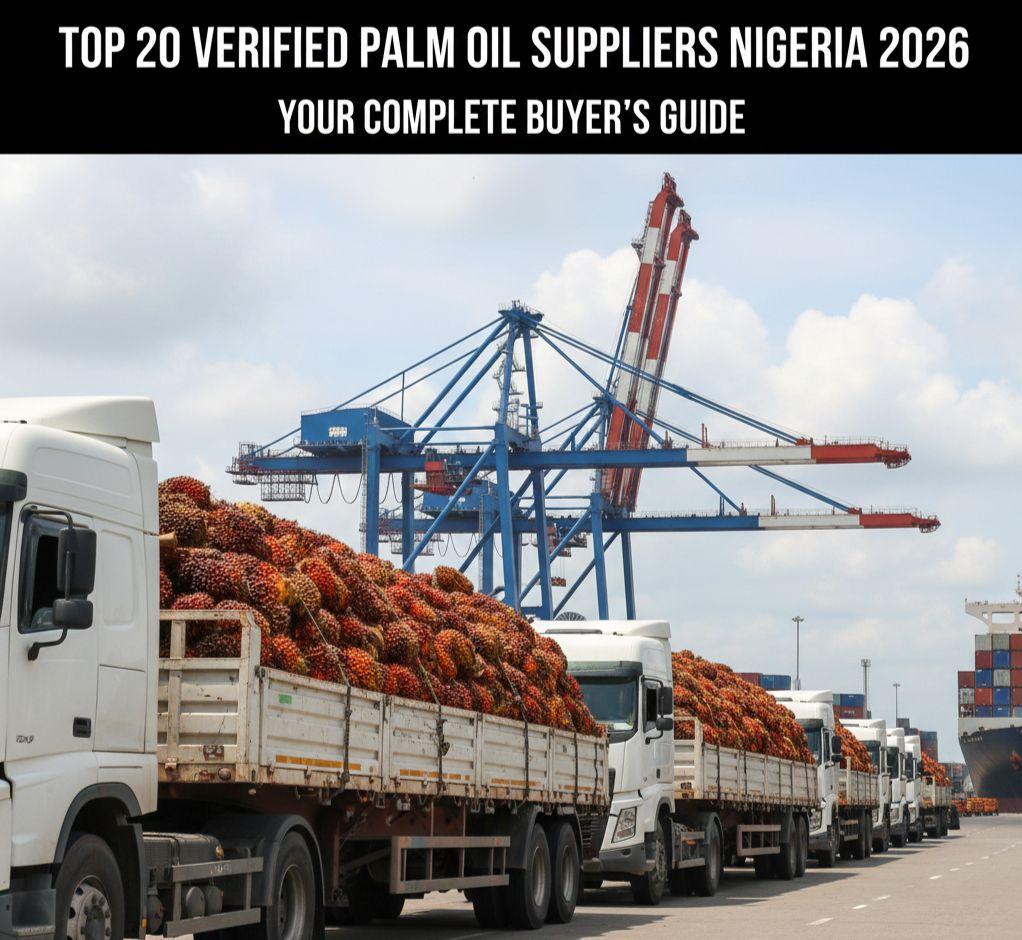
Top 20 Verified Palm Oil Suppliers in Nigeria 2026: Your Complete Buyer's Guide
Let me ask you something: have you tried sourcing palm oil from Nigeria lately? If you have, you've probably noticed the market's gotten complicated. Production shortfalls, price volatility, and a confusing mix of suppliers claiming they can deliver what you need.
I get it. You're looking for reliable suppliers who can actually fulfill bulk orders, who have the certifications you need, and who won't leave you hanging when it's time to ship. You want crude palm oil for refining, refined palm kernel oil for cosmetics, or maybe red palm oil for specialty food products, and you need it from suppliers you can trust.
Nigeria's palm oil sector is massive, but navigating it without local knowledge? That's where things get tricky. So I've done the legwork for you, vetting 20 top suppliers across different regions, product types, and scales of operation.
Why Nigeria for Palm Oil?
Nigeria was once the world's largest palm oil producer. That crown's long gone to Southeast Asia, but here's what hasn't changed: Nigeria still produces some of the highest-quality palm oil on the continent, particularly for specialty markets.
The country's climate creates ideal conditions for oil palm cultivation. The South-South and Southeast regions, especially Edo, Delta, Cross River, and Imo states, host the bulk of production. These aren't just random farms scattered around; we're talking established estates with decades of experience and smallholder cooperatives that have perfected traditional processing methods.
But 2026 brings specific challenges. Production shortfalls driven by aging plantations, policy shifts, and rising domestic demand have created a tight supply situation. Translation? Prices are up, but opportunities exist for buyers willing to work directly with vetted suppliers rather than relying on middlemen.
What You Need to Know Before Buying
Who are the top palm oil suppliers in Nigeria for bulk purchases?
The landscape splits into three main categories: large estate producers like Presco and Okomu, mid-sized processors and refiners like Okitipupa Oil Palm, and smallholder cooperatives coordinated through organizations like NIFOR (Nigerian Institute for Oil Palm Research).
Estate producers offer consistency and volume. If you need 500 MT of crude palm oil monthly with predictable specifications, estates deliver. Mid-sized processors provide flexibility with custom refining, fractionation, and packaging requirements. Smallholder cooperatives? They're your go-to for specialty products like virgin red palm oil and traditional processing methods that preserve unique nutritional profiles.
What are current wholesale prices for palm oil from Nigerian producers?
As of early 2026, wholesale prices for crude palm oil (CPO) hover around ₦1,200,000-₦1,400,000 per metric ton (roughly $800-$950 USD at current exchange rates). That's up about 25% from 2024 levels due to supply constraints.
Refined palm oil runs ₦1,500,000-₦1,700,000 per MT. Palm kernel oil (PKO), which commands premium pricing for cosmetic applications, ranges from ₦1,800,000-₦2,200,000 per MT. Red palm oil for specialty markets? Expect ₦1,600,000-₦2,000,000 per MT depending on organic certification and processing methods.
These prices fluctuate based on harvest cycles (peak season runs July-September), international market dynamics, and naira exchange rates. Always request current quotes rather than relying on historical pricing.
Finding and Verifying Legitimate Suppliers
Where can I find verified crude palm oil (CPO) suppliers in Nigeria?
This is where most international buyers stumble. Google searches return outdated listings, company websites are often inactive, and distinguishing legitimate operations from middlemen posing as producers is genuinely difficult without local expertise.
Your best approach? Work through established sourcing platforms that specialize in African products. Kuraway, for instance, maintains a vetted database of Nigerian palm oil suppliers with verified production capacity, export documentation, and quality certifications. They handle the due diligence so you don't have to fly to Lagos to inspect operations yourself.
You could also contact NIFOR directly for their approved supplier directory, reach out to the Palm Oil Millers Association of Nigeria (POMAN), or work with commodity trading firms with Nigerian operations. Each has advantages, but platforms like Kuraway streamline the entire vetting and connection process.
Certifications and Quality Standards
Are there RSPO-certified sustainable palm oil suppliers in Nigeria?
Honestly? RSPO (Roundtable on Sustainable Palm Oil) certification in Nigeria lags significantly behind Southeast Asian producers. As of 2026, only a handful of large estates have achieved RSPO certification, and the process remains expensive and administratively complex for smaller operations.
If RSPO certification is non-negotiable for your market (particularly EU buyers facing regulatory requirements), your supplier options narrow considerably.
However, many Nigerian suppliers meet equivalent quality and sustainability standards. Look for ISO 9001 quality management certification, NAFDAC (National Agency for Food and Drug Administration and Control) registration for food-grade products, SON (Standards Organisation of Nigeria) certification, organic certification from recognized bodies, and export quality approval from Nigerian Export Promotion Council (NEPC).
Top 20 Verified Palm Oil Suppliers in Nigeria
Let me walk you through the suppliers worth your attention, organized by product specialization and scale of operation.
Large Estate Producers (500+ hectares)
1. Presco Plc Location: Edo and Delta States
Presco's the heavyweight champion of Nigerian palm oil. With over 30,000 hectares under cultivation, they produce crude palm oil, palm kernel oil, palm kernel cake, and shells. They're publicly traded, which means transparent financial reporting and accountability you won't find with smaller operations.
Production capacity runs about 60,000 MT of CPO annually. They supply both domestic and export markets, with established logistics for container shipping from Lagos and Warri ports. Quality consistency is their strength. FFA levels stay predictable, moisture content meets export standards, and supply continuity rarely breaks down.
Best for: High-volume crude palm oil orders (50+ MT), palm kernel shells for biomass export, buyers needing quarterly contracts with predictable specifications.
2. Okomu Oil Palm Company Location: Edo State
Okomu operates about 18,000 hectares of oil palm estates with integrated milling facilities. They've invested heavily in sustainable practices and modern processing equipment, producing CPO, refined palm oil, and palm kernel products.
Their refined palm oil meets international food safety standards and consistently performs well in lab testing. They've supplied major multinational food companies and have experience with export documentation, quality certifications, and international logistics coordination.
Best for: Refined palm oil for food manufacturing, buyers requiring consistent lab-verified specifications, medium to large volume orders (20-100 MT).
3. Okitipupa Oil Palm Company Location: Ondo State
Okitipupa's been around since 1976, which tells you something about their staying power. They operate estates and outgrower schemes, producing CPO, refined palm oil, and palm kernel oil. Their refinery capacity allows them to customize processing based on customer specifications.
They work with smallholder farmers through nucleus-estate schemes, which gives them access to additional fruit beyond their estate production. This flexibility helps during peak season when they can ramp up processing volume.
Best for: Customized refining specifications, buyers wanting support for sustainability narratives through smallholder linkages, flexible volume requirements.
Mid-Sized Processors and Refiners
4. Godrej Nigeria Location: Lagos State
Godrej's primarily known for consumer products, but their palm oil processing division supplies bulk PKO to soap and cosmetics manufacturers. They maintain strict quality controls for industrial applications and have established export logistics through Lagos ports.
Their palm kernel oil consistently meets the low iodine value (IV) requirements for soap manufacturing and maintains stable fatty acid profiles. If you're in personal care or industrial soap production, Godrej's a solid option.
Best for: Palm kernel oil for cosmetics and soap (10-50 MT orders), buyers needing Lagos port proximity, industrial-grade PKO specifications.
5. BUA Oil Mills Location: Niger State
Part of the BUA Group conglomerate, this operation benefits from integrated logistics and financial stability. They produce palm mid fraction for confectionery applications and can handle specialized fractionation requirements.
Their cocoa butter replacer specifications meet chocolate manufacturer standards, and they've exported to West African neighbors with good track records on delivery timelines.
Best for: Palm mid fraction for confectionery, buyers needing fractionated products, orders 15-40 MT.
6. P&B Foods Limited Location: Lagos State
P&B specializes in fractionated palm oil products, including medium-chain triglycerides (MCT) for health and nutrition markets. They're smaller scale but technically sophisticated, with modern fractionation equipment.
If you're sourcing for nutrition supplements, sports nutrition, or specialty food applications requiring specific triglyceride profiles, P&B can deliver products that most Nigerian processors don't even attempt.
Best for: MCT oil and specialized fractions, health supplement manufacturers, smaller volume specialty orders (5-20 MT).

Regional Cooperatives and Quality Smallholder Operations
7. Imo State Palm Produce Cooperative Location: Imo State
This cooperative aggregates production from over 2,000 smallholder farmers using traditional processing methods. They're your source for authentic red palm oil with deep orange-red color, strong aroma, and high carotenoid content that you can't get from industrial processing.
Quality varies more than estate production, so expect batch-to-batch differences. But for specialty food markets, organic stores, or ethnic food distributors targeting African diaspora communities, this authentic product commands premium pricing.
Best for: Virgin red palm oil (traditional processing), organic certification potential, smaller orders (2-10 MT), specialty food markets.
8. Cross River State Oil Palm Producers Association Location: Cross River State
Cross River's smallholders have organized around quality improvement and export market access. They've received technical support from NIFOR and international development programs, improving processing hygiene and quality consistency.
They produce CPO and red palm oil, with growing capacity for refined products. The association model provides some volume aggregation while maintaining smallholder benefits.
Best for: Buyers wanting smallholder sourcing stories, CPO and red palm oil, orders 5-25 MT, sustainability-focused brands.
9. Abia State Palm Oil Processing Cluster Location: Abia State
Abia's got density. Hundreds of small mills processing oil palm fruit within concentrated geographic areas. This cluster has been modernizing equipment and improving quality standards with state government support.
They can aggregate decent volumes (20-30 MT) through cluster coordination, and processing standards have improved significantly. Quality's more variable than estates, but prices can be competitive.
Best for: Cost-conscious buyers accepting slightly variable quality, CPO orders 10-30 MT, buyers willing to work with cluster coordination.
Specialty and Niche Product Suppliers
10. NIFOR Commercial Farm Location: Edo State
The Nigerian Institute for Oil Palm Research doesn't just research. They operate demonstration farms and sell high-yield seedlings, CPO, and PKO from their own production. Quality control is rigorous because they're demonstrating best practices.
Volumes are limited, but quality's excellent. They also provide technical consultation, which can be valuable if you're considering investing in Nigerian oil palm operations yourself.
Best for: High-quality seedlings for plantation establishment, small volume CPO/PKO with guaranteed specifications (2-5 MT), buyers wanting technical consultation.
11. Edo State Palm Oil Cooperative Network Location: Edo State
This network coordinates 15+ cooperatives across Edo State, aggregating production for export markets. They've invested in centralized quality testing and standardized processing protocols to reduce batch variation.
Red palm oil and CPO are their primary products, with growing refined oil capacity. The cooperative network structure provides better supply continuity than individual smallholders.
Best for: Red palm oil and CPO, buyers wanting cooperative sourcing models, orders 10-20 MT.
12. Delta State Palm Kernel Shell Exporters Location: Delta State
Specialized supplier focusing on palm kernel shells (PKS) and palm kernel cake as biomass and animal feed products. They aggregate byproducts from multiple mills, providing consistent supply for export markets (primarily Asia).
PKS export for biomass energy is a growing niche, and Delta suppliers have established logistics to handle bulk shipments efficiently.
Best for: Palm kernel shells for biomass energy, palm kernel cake for animal feed, bulk orders 100+ MT, Asian markets.
Emerging and Growth-Oriented Suppliers
13. Rivers State Integrated Palm Mill Location: Rivers State
Newer operation (established 2021) with modern equipment and strong state government backing. They're building export capacity and have invested in quality certifications to access international markets.
Production's still ramping up, but they're eager for long-term buyer relationships and willing to accommodate specific processing requirements to establish themselves.
Best for: Buyers wanting to establish early relationships with emerging suppliers, CPO and refined oil, medium orders (15-35 MT).
14. Akwa Ibom Palm Products Ltd Location: Akwa Ibom State
Family-owned operation that's expanded from smallholder roots into a mid-sized processor. They maintain traditional quality approaches while adopting modern hygiene standards.
Red palm oil and palm kernel oil are specialties, with good reputations in regional markets. They're working on export certification and actively seeking international buyers.
Best for: Red palm oil with traditional quality, PKO, buyers willing to support supplier export development, orders 8-25 MT.
15. Anambra Palm Oil Refiners Association Location: Anambra State
Association of small-scale refiners who've pooled resources for export market access. They purchase CPO from various sources and refine to customer specifications.
Quality control has improved through association standards, and they offer flexibility on packaging and labeling for private label buyers.
Best for: Refined palm oil with custom packaging, private label products, smaller flexible orders (5-15 MT).
Certified Organic and Premium Suppliers
16. Ondo Organic Palm Cooperative Location: Ondo State
One of the few operations with legitimate organic certification from international certifying bodies. They've invested years in converting smallholder farms to organic practices and maintaining certification standards.
Production volume is limited, but premium pricing in organic markets justifies the effort. If you're supplying organic food stores or natural product companies in the US/EU, this is a rare verified organic source.
Best for: Certified organic red palm oil and CPO, premium specialty markets, smaller orders (3-10 MT), buyers needing organic certification documentation.
17. Bayelsa Virgin Palm Oil Producers Location: Bayelsa State
Traditional processors in Bayelsa's riverine areas produce virgin red palm oil using centuries-old methods. The oil's distinctive flavor profile and nutritional properties appeal to health-conscious consumers and traditional medicine markets.
Logistics can be challenging due to remote locations, but the product authenticity is unmatched. They're working through aggregators to improve export access.
Best for: Premium virgin red palm oil, traditional/medicinal markets, ethnic food distributors, orders 2-8 MT.
Industrial Byproduct Specialists
18. Lagos Palm Acid Oil Traders Location: Lagos State
Specialized trader aggregating palm acid oil (a refining byproduct) from multiple refiners. This lower-grade product serves industrial soap manufacturing, animal feed formulation, and biodiesel production.
If you're in industrial applications rather than food, palm acid oil offers significant cost advantages. Lagos location provides easy export logistics.
Best for: Palm acid oil for industrial applications, soap manufacturing, biodiesel, bulk orders 30-100 MT.
19. Enugu Palm Kernel Cake Suppliers Location: Enugu State
Focus on palm kernel cake (PKC) as animal feed ingredient. They aggregate PKC from oil mills across the Southeast and have established export procedures for West African and European buyers.
PKC protein content (18-20%) makes it valuable for livestock feed formulation, and Nigerian PKC often tests well for quality parameters.
Best for: Palm kernel cake for animal feed, livestock nutrition companies, bulk orders 50-200 MT.
20. Port Harcourt Palm Fractions Exchange Location: Rivers State
Trading platform connecting buyers with multiple suppliers for specialized fractions like palm stearin, palm olein, and various melting point specifications for industrial applications.
They don't produce directly but vet suppliers and facilitate transactions, providing quality assurance and logistics coordination. Think of them as a specialized commodity broker for palm fractions.
Best for: Specialized fractions (stearin, olein), buyers needing multiple fraction types, industrial applications, orders 10-40 MT.
Understanding MOQs and Lead Times
What is the minimum order quantity (MOQ) for Nigerian palm oil suppliers?
This varies dramatically by supplier type. Large estates typically require 50-100 MT minimum orders. They're set up for bulk production and container-load shipments. Smaller MOQs don't make economic sense for their operations.
Mid-sized processors often accept 20-50 MT orders, with some flexibility depending on the product. Cooperatives and smallholder aggregators can work with 5-25 MT orders, though per-unit costs increase at lower volumes.
Specialty products like organic red palm oil or specific fractions? MOQs might drop to 2-10 MT because these products command premium pricing that justifies smaller batches.
Lead times run 2-6 weeks typically, longer during off-season when fresh fruit supply tightens. Plan major purchases around peak season (July-September) when supply is strongest and prices most competitive.
The Documentation You'll Need
What documents are needed to import palm oil from Nigerian suppliers?
Get ready for paperwork. From the supplier side, you need Certificate of Origin from NEPC, Phytosanitary Certificate from Nigeria's Plant Quarantine Service, Quality/Analysis Certificate from an accredited laboratory showing FFA levels and other specs, Export Permit from NEPC, Commercial Invoice, Packing List, and Bill of Lading.
From your end as importer, you'll need appropriate import licenses depending on your country. US buyers generally don't need special licenses for palm oil, but EU buyers should verify food safety import requirements.
Working with experienced sourcing platforms like Kuraway simplifies this documentation maze significantly. They know which certificates are genuinely required, can coordinate with suppliers to ensure proper documentation, and can flag potential customs issues before your shipment leaves Nigerian ports.
Quality Control Reality Check
How reliable are smallholder palm oil producers versus large estates?
Let me be straight with you: large estates offer more consistency, but smallholders can deliver superior quality for specific products.
Estates benefit from standardized processes, modern equipment, and quality management systems. Batch-to-batch variation is minimal. If you need 500 MT of CPO with FFA consistently below 3.5%, estates deliver that predictability.
Smallholders produce more variable quality because processing methods, equipment age, and fruit handling practices differ across producers. One batch might test beautifully; the next might have higher moisture or FFA levels.
But smallholders do traditional processing better. Virgin red palm oil from smallholder cooperatives has higher carotenoid content, more complex flavor profiles, and authenticity that health-conscious consumers value.
Your quality control strategy should include pre-shipment inspection by third-party agencies (SGS, Intertek, Bureau Veritas), sample testing before full orders, regular audits for suppliers you work with long-term, and clear specifications in purchase contracts.
Why Location Matters
How do I contact palm oil exporters in Lagos or Delta State?
Geography significantly impacts your sourcing strategy. Lagos offers the best port infrastructure. Most international shipments move through Apapa or Tin Can ports. If minimal shipping complications matter to you, Lagos-based suppliers or those with Lagos warehousing make life easier.
Delta State hosts major estate producers and has Warri port for shipments. The state's concentrated palm oil industry means good supplier options and competitive pricing.
Edo State is production heartland. Benin City and surrounding areas have the highest density of estates, mills, and processing facilities. Quality's often best here because fruit gets processed faster, reducing FFA levels. But logistics requires moving product to Lagos or Warri for international shipping.
Southeast states (Abia, Imo, Anambra) excel in traditional processing and smallholder production. If you want authentic red palm oil or cooperative sourcing stories, this is where you look.
Your strategy? Match product type to region: bulk CPO from estates in Delta/Edo, specialty products from Southeast cooperatives, refined products from Lagos processors.
The Kuraway Advantage
I've mentioned Kuraway several times. Let me explain why this matters for Nigerian palm oil sourcing specifically.
Finding suppliers isn't hard. Google delivers hundreds of results. Finding legitimate, verified, reliable suppliers who actually have product, who meet international standards, and who won't disappear when problems arise? That's exponentially harder.
Kuraway specializes in exactly this challenge. They maintain relationships with Nigerian palm oil suppliers, conduct facility audits, verify certifications, and continuously monitor performance. When you source through their platform, you're accessing pre-vetted suppliers who've already proven export capability, quality standards, and financial stability.
They provide quality assurance systems including sample verification and pre-shipment inspection coordination. Their logistics support connects you with reliable freight forwarders and handles export documentation. And if something goes wrong, having a third party who knows both sides and has leverage with suppliers dramatically improves problem-solving speed.
Think of it as insurance against the dozens of ways international sourcing can go sideways. Yes, you pay for the service, but compare that cost to a single failed shipment, quality dispute, or fraud incident.
Red Flags to Avoid
Not every supplier claiming to export Nigerian palm oil is legitimate. Watch for prices significantly below market (if CPO is selling at ₦1,200,000/MT and someone offers ₦800,000/MT, run), unwillingness to provide samples, vague documentation about facility location or certifications, pressure for large advance payments before establishing trust, communication inconsistencies, and no verifiable track record of successful exports.
Using platforms like Kuraway largely eliminates these risks because supplier vetting happens before they're listed.
Your Action Plan
Ready to start sourcing Nigerian palm oil? Clarify your exact requirements (product type, specifications, volume needs, delivery schedule, and certification requirements). Identify 3-5 suppliers matching your needs. Request samples and test them in your facilities or independent labs. Verify supplier credentials. Negotiate terms and put everything in a detailed written contract. Arrange pre-shipment inspection. Coordinate logistics. Establish quality monitoring systems for ongoing orders.
Build relationships beyond transactions. Nigerian business culture values personal relationships. Suppliers who feel valued as partners deliver better service than those treated as purely transactional vendors.
Final Thoughts
Nigeria's palm oil sector offers genuine opportunities for buyers willing to navigate its complexities. You won't find the industrial-scale efficiency of Malaysian operations or the infrastructure maturity of Indonesian suppliers. But you will find competitive pricing (especially for specialty products), unique quality profiles particularly for traditional red palm oil, growing supplier sophistication, proximity advantages for Atlantic shipping routes, and supplier relationships where you're valued rather than being customer #1,847.
The key is approaching Nigerian sourcing strategically. Understand regional differences, match supplier types to your needs, verify quality rigorously, and build genuine partnerships.
Whether you're importing containers of CPO for industrial refining, sourcing specialty red palm oil for organic food stores, or securing PKO for cosmetics manufacturing, the right Nigerian suppliers can deliver quality and value.
Start with verified suppliers, test thoroughly, build gradually, and you'll develop a Nigerian palm oil supply chain that diversifies your risk while accessing a dynamic, growing market.
Ready to connect with verified Nigerian palm oil suppliers?
Browse vetted exporters, compare specifications, and start building reliable African supply chains at Kuraway.com. Filter by product type, region, and certifications to find suppliers matching your exact requirements, with quality assurance and logistics support throughout the process.